A winning listing presentation isn't just a slide deck—it’s a conversation built on trust. And that trust? It’s earned long before you ever open your laptop. The agents who consistently walk away with the signature are the ones who do their homework, digging deep into the seller's world to understand their unique needs and goals.
Building Your Presentation Before You Build Your Slides

The real magic happens in the prep work. Showing up with a generic, one-size-fits-all pitch is the fastest way to lose. It screams that you haven't invested any real thought into their specific situation.
When you do the upfront work, you shift the dynamic. It’s no longer a monologue about your sales record; it becomes a dialogue focused entirely on their future. This foundational research makes your case so compelling that by the time you get to the marketing plan, signing with you feels like the only logical next step.
Conduct Thorough Pre-Meeting Research
Your research has to go way beyond just pulling comps. You need to become a mini-expert on their property, their story, and their neighborhood before you ever ring the doorbell.
Here’s where to start digging:
- Property Details: Pull the tax records and any past MLS listings. Get a feel for the home's history, what makes it unique, and any improvements that have been made.
- Seller Background: A quick social media search can tell you a lot. A new baby, a job announcement, or an empty nest can give you clues about their real motivation for selling.
- Neighborhood Vibe: Don't just rely on Google Maps. Drive the neighborhood at different times of the day. Is there a new coffee shop opening up? Is there construction nearby? These small details show you’ve done more than the bare minimum.
This homework arms you with the context to ask smarter questions and connect with the seller from the very first hello.
Uncover Seller Motivations and Pain Points
That first phone call or email exchange is your golden opportunity for discovery. Ditch the sales pitch for a minute and focus on asking open-ended questions to figure out their "why."
You need to get past the surface-level answers like, "we need more space." What's really driving this move? Are they stressed about a tight timeline for a new job? Worried about getting a specific price to fund their retirement? Anxious about the chaos of showings with two toddlers at home?
When you truly listen, you collect the exact ammunition you need to frame your entire presentation around solving their specific problems.
Deploy a Professional Pre-Listing Package
Sending a pre-listing package 24-48 hours before your meeting is a total power move. It instantly establishes your professionalism, warms them up to you, and gets the basic questions out of the way so you can use your in-person time for what really matters.
A solid real estate seller questionnaire and document collection process is key here, helping you gather everything you need to build a strong presentation. Keep your package concise but packed with value—you want to inform, not overwhelm.
A great pre-listing package usually includes:
- A short and sweet bio that focuses on your value, not just your stats.
- A few glowing testimonials, ideally from past clients in their area.
- A simple, visual overview of the selling process from start to finish.
- A sneak peek at the market to start managing expectations early.
This simple gesture means you walk in the door not as a stranger, but as a trusted advisor who’s already on the job. By automating parts of this process, you can tap into some serious time-saving strategies for real estate agents and free yourself up to focus on building that all-important client relationship.
A great listing presentation isn't just a binder full of stats. It's a story.
In this story, your seller is the main character trying to get from Point A (listed) to Point B (sold, for the best price), and you’re their trusted guide. A presentation with a logical, compelling narrative builds momentum, making your pricing recommendation feel like the only logical conclusion to a well-thought-out plan.
Forget about just throwing slides together. Each piece of your presentation should connect to the next, guiding the seller from understanding the current market to seeing your unique strategy as their perfect solution. This is how you turn a simple pitch into a persuasive conversation.
Crafting a Powerful Opening
Your first few slides set the tone for the entire meeting. This is your chance to build immediate rapport and position yourself as a credible, empathetic advisor—not just another agent trying to get a signature.
Start by focusing entirely on them. Circle back to the specific goals and worries they shared with you in your first conversation. This proves you were actually listening and that this meeting is built around their needs, not your ego.
For example, you could open with, "I know your top priority is to get this sold before the new school year starts, and you’re worried about minimizing disruptions for the kids. My entire plan today is designed to hit that timeline while making the process as smooth as possible for your family." This simple act of reflecting their own words back to them creates an instant connection.
Key Takeaway: The best presentations start with empathy. Show the seller you understand their specific situation before you dive into your marketing plan or personal stats. This one small shift can change the entire dynamic of the meeting.
Detailing Your Custom Marketing Strategy
Once they know you get it, it’s time to show them how you're going to get the job done. This is the heart of your presentation, where you pull back the curtain on your custom marketing plan. This section absolutely has to be visual, specific, and focused on the benefits—not just a laundry list of features.
Don't just say you'll use "professional photography." Show them a side-by-side comparison of a home shot on a phone versus one captured by your pro photographer. Explain how incredible images lead to more online clicks and a higher perceived value from day one.
Break down your marketing plan like a multi-channel attack, so they can see all the moving parts.
- Pre-Launch Buzz: Talk about your "coming soon" strategy. Explain how you'll build anticipation among local agents and your buyer network before the home even officially hits the market.
- Digital Dominance: Show them actual examples of your social media ads, targeted email blasts, and how you secure premium placement on the big real estate sites. More importantly, explain who these tactics will reach.
- Staging and Visuals: Discuss your approach to staging. Is it a full-service deal or a consultation to help them declutter and prepare? This is the place to show off virtual tours or drone photography you’ve used for similar homes.
- The Showing Experience: Walk them through how you'll manage showings to make it convenient for them while making sure every potential buyer sees the home at its absolute best.
To keep them engaged, you need to turn your monologue into a dialogue. One of the best ways to do this is to learn how to make presentations interactive and pull the seller into the conversation. Ask questions like, "Can you see how this type of ad would catch the eye of buyers looking for a great backyard just like yours?"
Weaving in Your Track Record and Social Proof
After you’ve laid out your forward-thinking marketing plan, it's time to back it all up with proof. This is where you show them you don’t just make promises—you have a history of delivering results.
But please, no boring "About Me" slide. Instead, weave your successes directly into the marketing conversation. When you're talking about your digital ad strategy, follow it up with a quick case study: "For the home over on Maple Street, which is a lot like yours, this exact ad strategy brought in 3 qualified showings in the first 48 hours."
Showing your data visually is always more powerful than just listing numbers.
Finally, sprinkle in client testimonials where they make the most sense. Instead of a generic "reviews" slide, drop a relevant quote right after you explain a key service. For example, after you explain your negotiation strategy, pop in a quote from a past client who raved about the incredible deal you secured for them. Contextual proof like this feels far more authentic and makes your entire presentation more trustworthy.
Presenting a Data-Driven Pricing Strategy
This is it—the moment your listing presentation shifts from a marketing showcase to a strategic consultation. The Comparative Market Analysis (CMA) isn't just a list of sold homes; it's where you interpret the data to tell a compelling, evidence-based story about their property's value right now.
Get this part right, and you’re no longer just an agent. You’re a trusted advisor. Your entire goal is to guide the seller away from an emotional price tag toward a logical, market-backed number. You aren't dictating the price—you're laying out the evidence so clearly that they arrive at the same conclusion you have.
Turning Data Into a Persuasive Narrative
Sellers don't want a data dump. They want clarity. Resist the urge to overwhelm them with a dozen comps and a complicated spreadsheet. Instead, curate your CMA to spotlight only the most relevant properties and then walk them through your thought process for each one.
Start with your best matches—the homes most similar in location, size, age, and condition. Then, explain why you chose them. It’s as simple as saying, "I picked this home on Oak Avenue because it has the same updated kitchen and square footage, and it sold just three weeks ago. This gives us the strongest signal of what buyers are willing to pay today."
This is where you build on the core pillars of any successful pitch: building rapport, showcasing your marketing, and nailing the price.
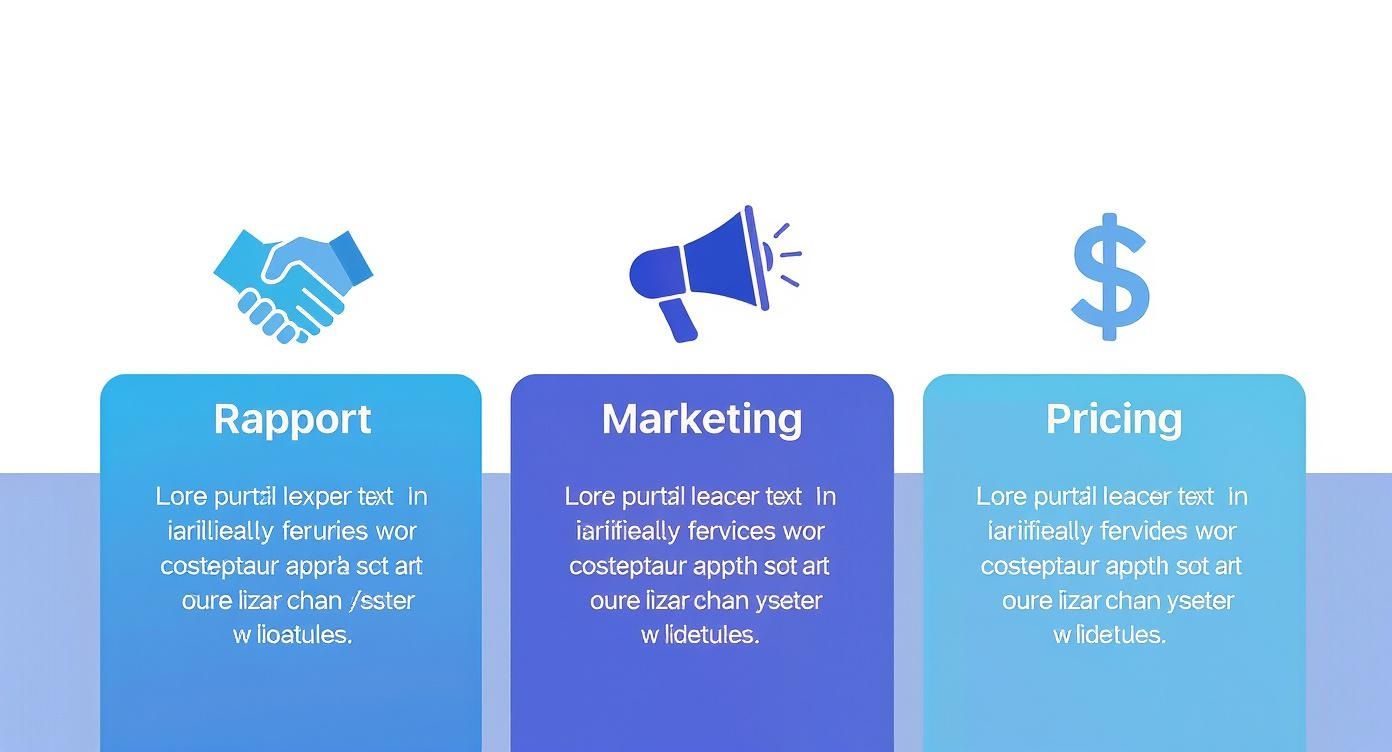
While rapport and marketing get you in the door, a rock-solid pricing strategy is the foundation that makes the entire sale work.
A strong CMA is built on more than just sold prices. Including key market metrics shows you've done your homework and gives sellers a broader context for their decision.
Key Market Metrics to Include in Your CMA
These data points transform vague promises into measurable evidence, building immense seller confidence in your expertise. To dig deeper, check out this guide on using market metrics in your real estate listing presentation.
Explaining Adjustments and Market Conditions
After presenting the core comps, you need to explain your adjustments. This is where you really flex your market expertise. Don't just say a finished basement adds value; put a number on it based on what you're seeing in the market.
- Feature Adjustments: "We've added $15,000 to this comp's value because it doesn't have the in-ground pool your property features, and pools are a huge draw in this neighborhood."
- Condition Differences: "On the flip side, the home on Pine Street sold for a premium because it had a brand-new roof. We need to account for that by adjusting downward slightly, as that’s a major expense a new buyer won't have to worry about."
Your ability to clearly explain these adjustments is what separates a professional analysis from a Zillow estimate. You’re connecting the dots for the seller, showing them the logic behind every single number.
Visualizing the Risks of Overpricing
The most common point of friction is almost always the seller who wants to "test the market" with a high price. Instead of arguing, let the data do the talking. A simple chart or graph showing the relationship between "Days on Market" and the final "Sale-to-List Price Ratio" is incredibly persuasive.
You can frame it like this: "Homes in our area that sell in the first 14 days typically get 99% or more of their asking price. But look what happens after 45 days—that number drops closer to 95%. That initial overpricing can end up costing you more in the long run than pricing it correctly from day one."
This isn't a confrontation. It’s an education, protecting your seller's bottom line by showing them how to get the highest possible price in the shortest amount of time.
Showcasing Your Unique Value and Proven Track Record

Okay, you’ve nailed the CMA and laid out a killer marketing plan. The seller is impressed. But now comes the real question, even if they don't say it out loud: "So, why should we hire you?"
In a market swimming with agents, sellers aren’t just hiring a brokerage; they're choosing the one person they trust to get the job done right. This is your moment to connect your strategy to your results. It's time to prove that your process isn't just theory—it's a repeatable formula for success.
This isn't about some generic "About Me" slide filled with decade-old awards. It’s about translating your expertise into a direct benefit for the person sitting across from you. Your track record is the hard evidence that your marketing and pricing strategies actually work. It’s what gives them the confidence to sign on the dotted line.
From Stats to Success Stories
Let's be honest, raw numbers can make people's eyes glaze over. The trick is to turn those performance metrics into compelling visuals that tell a story. Don't just list your total sales volume. Focus on the numbers that hit home for a seller: their final sale price and their time on market.
One of the most effective ways to do this is with a simple, powerful comparison table. Pit your performance directly against the local MLS average.
This little table does a lot of heavy lifting. It instantly shows your value in the three areas that matter most: getting them more money, selling their home faster, and actually closing the deal.
You can frame it like this: "On average, my clients' homes sell more than twice as fast as other listings in the area. But more importantly, they consistently walk away with more money than their original asking price."
The Power of Social Proof
While your stats make the logical case, social proof builds the emotional trust you need to seal the deal. This is where client testimonials and case studies become your secret weapons. They're third-party validation that you deliver on your promises.
But don't just cram all your reviews onto one slide. That's a missed opportunity. Instead, sprinkle them strategically throughout your presentation to back up your claims in real time.
- Right after your marketing plan? Drop in a testimonial from a client who raved about your stunning photography and social media blitz.
- When you discuss your negotiation strategy? Share a quick story from a seller who was blown away by the final price you got them.
- As you explain your process? Use a quote from a past client who said you made everything feel smooth and stress-free.
Placing them contextually reinforces every point you make. To keep all these elements looking sharp and professional, check out our guide on the best practices for on-brand property marketing materials.
Presenting Your Tangible Evidence
Every strong listing presentation needs to include your personal sales stats. It's non-negotiable. Showing a seller your list-to-sale price ratio or proving your listings fly off the market faster than the neighborhood average has a huge psychological impact. These aren't just numbers; they are concrete proof of your skill.
When you combine your personal wins with your deep local market analysis, you build an airtight case for why you're the only agent for the job.
Key Takeaway: Your track record isn't a brag sheet—it's the ultimate proof that you can solve the seller's problem. By presenting tangible evidence of your performance, you remove the risk from their decision and make choosing you the most logical, reassuring option on the table.
Mastering Your Delivery and Handling Seller Objections
You can have the most beautiful, data-packed listing presentation in the world, but it can all fall apart without a confident delivery. The slides and marketing materials are just your props; you are the main event. Your ability to truly connect with the seller, read the room, and guide the conversation is what wins trust and, ultimately, the listing.
This is where the art of the deal meets the science of sales. The presentation itself provides the logical framework, but it's your delivery that forges the crucial emotional connection. It’s about being a real person, listening intently, and showing them you’re the steady hand they need to guide them through a stressful process.
Reading the Room and Building Rapport
The presentation starts the second you walk through their door. Your first job is to shift the entire dynamic from a formal pitch into a collaborative conversation. How? Start by asking for a tour of the home.
This simple request accomplishes several things at once. First, it lets you see the property through their eyes and hear what they truly love about it. Second, it gives you a golden opportunity to build genuine rapport in a low-pressure setting, long before you even open your laptop. As you walk through, your job is to listen more than you talk.
The best agents know that a listing presentation is a dialogue, not a monologue. Pay close attention to the seller's body language and tone. Are they engaged and asking questions, or are they leaning back with their arms crossed? Adjust your energy and pace to match theirs.
If they seem anxious about the market, you’ll want to spend a little more time on your CMA and the hard data. If they light up when you talk about your marketing ideas, lean into that section. Your ability to adapt on the fly shows them you're actually listening to their needs, not just reciting a script.
Proactively Addressing Common Seller Objections
Seasoned agents don't see objections as roadblocks—they see them as opportunities. An objection means the seller is engaged and just needs more information or a bit of reassurance. The real pro move is to anticipate these concerns and weave the answers directly into your presentation before they even have a chance to ask.
In my experience, almost every objection falls into one of three buckets:
- Commission: "Why is your fee X%?"
- Pricing: "We think our house is worth more."
- Competition: "We're going to interview other agents."
By tackling these head-on, you control the narrative and position yourself as a transparent, confident professional. For instance, when you get to your marketing plan, that’s the perfect time to proactively address the commission question.
Example Script for Commission:"A comprehensive marketing plan like this, designed to get you the absolute highest price, involves a significant investment on my part. We're talking professional photography, targeted digital ads, and premium placement on all the top websites. My commission structure is what allows me to fully fund this strategy without cutting any corners, which ensures we attract the most qualified buyers and ultimately put more money in your pocket at closing."
This approach reframes your commission from a "cost" into an investment in a better outcome. Learning how to frame your value is one of the 10 essential steps to prepare for a successful sales call, and it's absolutely vital in a listing appointment.
Handling Tough Questions in the Moment
Even with the best preparation, you’re still going to get hit with direct questions. The key is to respond with empathy and pivot back to your value. Whatever you do, don't get defensive. Instead, just use this simple framework: Acknowledge, Respond, and Reframe.
The Pricing Objection
If a seller pushes back on your suggested list price, arguing it’s too low, avoid a direct confrontation.
- Acknowledge: "I completely understand why you feel your home is worth that much. You've put a lot of love and hard work into this place, and it really shows."
- Respond: "The challenge we have isn't about the home's true worth to you, but about how it stacks up against what qualified buyers are actually paying for similar homes right now. Let's pull up that comparable on Elm Street again..."
- Reframe: "My number one goal here is to get you the highest possible price in the shortest amount of time. Pricing it strategically right out of the gate creates a flood of interest and competition between buyers. That's what ultimately drives the price up and prevents your home from sitting on the market and going stale."
The "We're Interviewing Other Agents" Objection
This is probably the most common thing you'll hear. Treat it as a buying signal—it means they are serious about selling.
- Acknowledge: "That's fantastic. I think it’s a really smart decision to speak with a few professionals to make sure you find the perfect fit for your family."
- Respond: "So I know what to focus on, can I ask what you'll be looking for in the agent you choose? What are the most important qualities to you?"
- Reframe: This simple question shifts the entire dynamic. It allows you to listen to their decision-making criteria and then connect those exact needs directly back to the specific strengths you’ve already shown them, reinforcing why you’re the best choice without ever bad-mouthing the competition.
Answering Your Top Questions About Listing Presentations
Even after you've built what feels like the perfect deck, a few nagging questions can stick with you. Getting these details right is often what separates a good presentation from a great one—the kind that gets you the signature.
Let's clear up some of the most common questions I hear from agents.
What’s the Ideal Presentation Length?
Your sweet spot is 20 to 30 minutes for the core presentation. This gives you enough runway to cover the market, your marketing plan, your value, and your pricing strategy without making the seller feel like they're trapped in a lecture.
But remember, this is a guide, not a stopwatch. If the seller is engaged and firing off questions, let the conversation breathe. The goal is to be thorough but efficient, respecting their time while building a genuine connection. Your slides are there to guide the conversation, not dictate it.
Should I Go Digital or Bring a Physical Copy?
Why not both? A sharp digital presentation on a tablet or laptop looks modern and lets you do cool things like play a video tour or show off interactive market charts. It signals that you're tech-savvy.
But always leave behind a high-quality, professionally printed copy. It’s a tangible reminder of your value long after you’ve left. Plus, if your iPad suddenly dies or the Wi-Fi acts up, you have a bulletproof backup.
What's the Single Biggest Mistake to Avoid?
Easy. Making the presentation all about you. So many agents lead with a parade of their own awards, sales volume, and accomplishments. While you absolutely need to build credibility, the entire presentation has to be filtered through the lens of the seller's problems and goals.
Don't just state your stats; connect them directly to a benefit for the client. Instead of, "I sold 50 homes last year," try something like, "My experience selling 50 homes last year gives me a powerful network of agents and active buyers I can immediately tap into for your property." Always listen first, then connect your skills to their specific situation.
How Can I Actually Stand Out from the Competition?
Customization. This is your secret weapon. Your competitors are probably showing up with the same generic, brokerage-branded template they use for every appointment. You win by proving you've done your homework on their home and their goals.
A presentation that shows you've invested real time and effort will always win.
- Weave their personal timeline and motivation into the conversation.
- Call out unique features of their home and show exactly how you'll market them.
- Use hyper-local, truly relevant comps in your CMA, not just a boilerplate data dump.
This level of personalization tells the seller you see them as a partner, not just another transaction. It’s the clearest way to demonstrate a higher standard of care.
Ready to build a standout real estate listing presentation in minutes, not hours? Bounti Labs uses AI to automatically research property data, draft compelling CMAs, and generate a complete, on-brand marketing kit for every listing. Learn how to automate your prep work and win more listings with Bounti.ai.