
A virtual real estate assistant is a remote professional who handles the administrative, marketing, and operational tasks that keep a real estate business running. They take the time-sucking back-office work off your plate, freeing you up to focus on clients and close deals.
Think of them as a strategic partner—the key to growing your business without piling on the overhead of a full-time, in-office hire.
The Modern Agent's Secret to Scaling Your Business

Let’s be real. The daily grind for a successful agent is a whirlwind of juggling client calls, managing mountains of paperwork, coordinating showings, and trying to keep marketing consistent. It's a balancing act where the crucial, non-revenue-generating tasks can easily swallow your entire day.
This is the exact spot where so many agents hit a wall. They get stuck in the business instead of working on it, and growth grinds to a halt.
That’s where a virtual real estate assistant comes in. They aren't just a remote helper; they are your strategic partner in growth.
From Delegation to Multiplication
Stop thinking of a virtual assistant as just another expense. They're a force multiplier. Their job is to systematically take over the repetitive, energy-draining tasks, which in turn unlocks your time for the high-value activities that actually grow your income.
A virtual assistant isn't about simply offloading work. It's about strategically buying back your time to invest in what truly matters: negotiating deals, nurturing client relationships, and building your brand.
This shift in mindset is everything. You're not just hiring someone to answer emails. You're investing in a system that allows your business to operate and grow, even when you’re out showing properties. For a deeper look at the impact, check out the top 10 outsourcing benefits to scale your business.
Building a Sustainable Business Model
When you bring a virtual assistant on board, you start building a more resilient and profitable business. It forces you to create standardized processes for everything from client intake to transaction coordination, which means a consistent, high-quality experience for every client. For many agents, this is the key to finally smashing through frustrating income ceilings.
Today's real estate landscape also offers a powerful combination of human support and smart technology. You can learn more about how to use AI for real estate agents to make operations even smoother, empowering your VA to be more effective than ever.
Ultimately, a virtual real estate assistant is the foundational piece for building a business that's scalable, efficient, and a whole lot less stressful.
What a Virtual Real Estate Assistant Actually Does

Let’s clear something up: a virtual real estate assistant isn’t just a remote admin who answers a few emails. Think of them as the operational hub of your business, the person who handles all the critical, repeatable tasks that let you focus on what you do best—building relationships and closing deals.
They step in to manage everything from the first lead inquiry all the way through post-closing follow-up. This is a game-changer because most agents spend a staggering 30–40% of their day buried in administrative work. Bringing on a VA can slash that time, often leading to a 25% boost in lead response times and a 20% jump in conversions.
Administrative and Operational Support
This is where your VA makes an immediate impact—clearing out the daily clutter that drains your focus. They become the gatekeeper for your schedule and your inbox, giving you back hours every week.
- Calendar Management: They’ll schedule showings, book appointments with inspectors and photographers, and make sure your personal and professional calendars are perfectly synced to avoid any conflicts.
- Email and Communication: Your VA acts as your first line of defense, filtering your inbox, handling common questions, and flagging anything urgent. Nothing important gets missed.
- Database and CRM Entry: They’ll keep your CRM spotless by updating client details and logging every interaction, making sure your database is always a reliable source of truth.
Listing Coordination and Management
Getting a home on the market involves a mountain of small but crucial steps. A sharp VA can own this entire process, turning a chaotic launch into a smooth, professional rollout every single time.
A great VA doesn't just check off tasks; they manage entire workflows. They transform a messy listing launch into a standardized system that delivers a consistent, high-end experience for every client.
From entering property specs into the MLS to prepping listing presentations and coordinating with stagers, they handle it all. This frees you from micromanaging the details and ensures your listings always look their best. Pairing your VA with an AI real estate assistant can supercharge this process, letting them draft compelling property descriptions or marketing copy in seconds.
To give you a clearer picture, here’s a breakdown of how you can delegate tasks across different parts of your business.
The Real Estate VA Delegation Blueprint
This table maps out common tasks you can hand off to a VA and the direct benefit you’ll see in your own workflow.
By offloading these structured tasks, you’re not just saving time—you’re creating the bandwidth to focus on dollar-productive activities that actually grow your business.
Marketing and Client Care Execution
Consistent marketing is the engine of a healthy real estate business, but it's often the first thing that gets dropped when you're slammed. A virtual assistant keeps your marketing running like clockwork, so your brand stays top-of-mind and your pipeline stays full.
- Social Media Management: They can create and schedule posts, engage with your audience, and even run targeted ads to promote your listings.
- Content Creation: Need a property flyer, a monthly newsletter, or a blog post? Your VA can design and write compelling content that resonates with your audience.
- Client Follow-Up: They handle the little touches that build loyalty, like sending feedback requests after a showing, running email drip campaigns, or mailing out closing gifts.
Calculating Your Return on a Virtual Assistant
It’s easy to look at a virtual assistant as just another monthly expense, but that’s a huge mistake. A VA isn't a cost—it's an investment, and like any good investment, it should generate a clear, measurable return.
Let's move past the fuzzy idea of "time saved" and get down to the real numbers. How does a real estate assistant virtual actually impact your bottom line?
The most obvious return is in direct cost savings. When you hire a VA as an independent contractor, you immediately sidestep the heavy financial baggage that comes with a traditional, in-house employee.
- No Payroll Taxes: You’re not on the hook for Social Security, Medicare, or unemployment taxes.
- No Employee Benefits: Forget about the high costs of health insurance, retirement plans, or paid time off.
- No Office Overhead: You save on physical office space, extra utilities, and equipment you’d otherwise have to buy.
These savings make a VA a financially lean option right out of the gate. But the real value, the part that truly moves the needle, comes from the profit you generate when your time is freed up for dollar-productive activities.
The Real Value of Your Time
To really see the ROI, you have to know what an hour of your time is actually worth. This is a simple but eye-opening exercise.
First, figure out your target annual income—let's say it's $150,000. Now, divide that by the number of weeks you plan to work (maybe 50) and then by your average hours per week (say, 40).
Here's how that looks:
$150,000 / 50 weeks = $3,000 per week
$3,000 / 40 hours = $75 per hour
That $75 is your "dollar-productive" rate. Now, let’s compare that to a skilled VA, who might charge around $25 per hour. Every single hour you spend wrestling with a $25/hour administrative task is an hour you aren't spending on a $75/hour activity like negotiating a deal or nurturing a new lead.
Think about it this way: delegating 10 hours of admin work per week to a VA costs you $250. But that move frees up 10 hours for you to focus on high-value work, potentially generating $750 in value.
That’s a net gain of $500 per week.
This is precisely why the real estate virtual assistant service market is exploding. Analysts are projecting this niche to hit $1,250 million by 2025, because top agents everywhere are offloading the busywork to focus on what they do best: closing deals. You can check out the full report on market growth projections on Data Insights Market.
Once you frame the decision around profit instead of cost, the choice becomes crystal clear. A virtual assistant isn’t just about making your life easier; it’s about actively multiplying your earning potential. To dig deeper into this, check out our guide on the impact of automation on real estate agent productivity.
How to Find and Hire the Right Virtual Assistant
Finding the perfect virtual assistant can feel like hunting for a needle in a haystack. But it doesn't have to be. A little structure goes a long way.
Before you even start looking at profiles, the first move is to get brutally honest about what you actually need. Are you drowning in paperwork and just need a few hours of admin help a week? Or are you looking for a full-time partner to help run the entire back-end of your business?
Your answer points you to the right hiring model. Think of it this way: you wouldn't buy a two-seater sports car for a cross-country family road trip. In the same way, your specific business pain points will tell you whether a freelancer, an agency, or a direct hire is the right vehicle for growth.
Choosing Your Hiring Path
You’ve got three main roads you can go down when hiring a VA, and each comes with its own set of pros and cons. Getting familiar with them is the key to making a smart investment instead of a costly mistake.
Freelance Platforms: Sites like Upwork and Fiverr are massive marketplaces teeming with talent. They’re fantastic if you have a specific, one-off project, like designing a new listing flyer or cleaning up a messy spreadsheet. The catch? You have to do all the heavy lifting—vetting, interviewing, and managing them yourself.
Specialized VA Agencies: Companies like MyOutDesk or Virtudesk are the specialists. They find, train, and manage virtual assistants specifically for the real estate grind. This saves you a ton of time on training, as you’re getting someone who already knows the lingo and the workflow. It's a great choice for agents who need a skilled pro to hit the ground running, but it does come with a higher price tag.
Direct Hires: This is the traditional route—finding and hiring an independent contractor on your own through your network or job boards. This path gives you the most control and helps build a deep, long-term working relationship. Of course, it also means you’re on the hook for every single part of the process, from recruiting to payroll.
For a lot of agents, the decision to hire is the first real step toward scaling up. It’s a big move. This chart can help you think through whether it’s the right one for you.
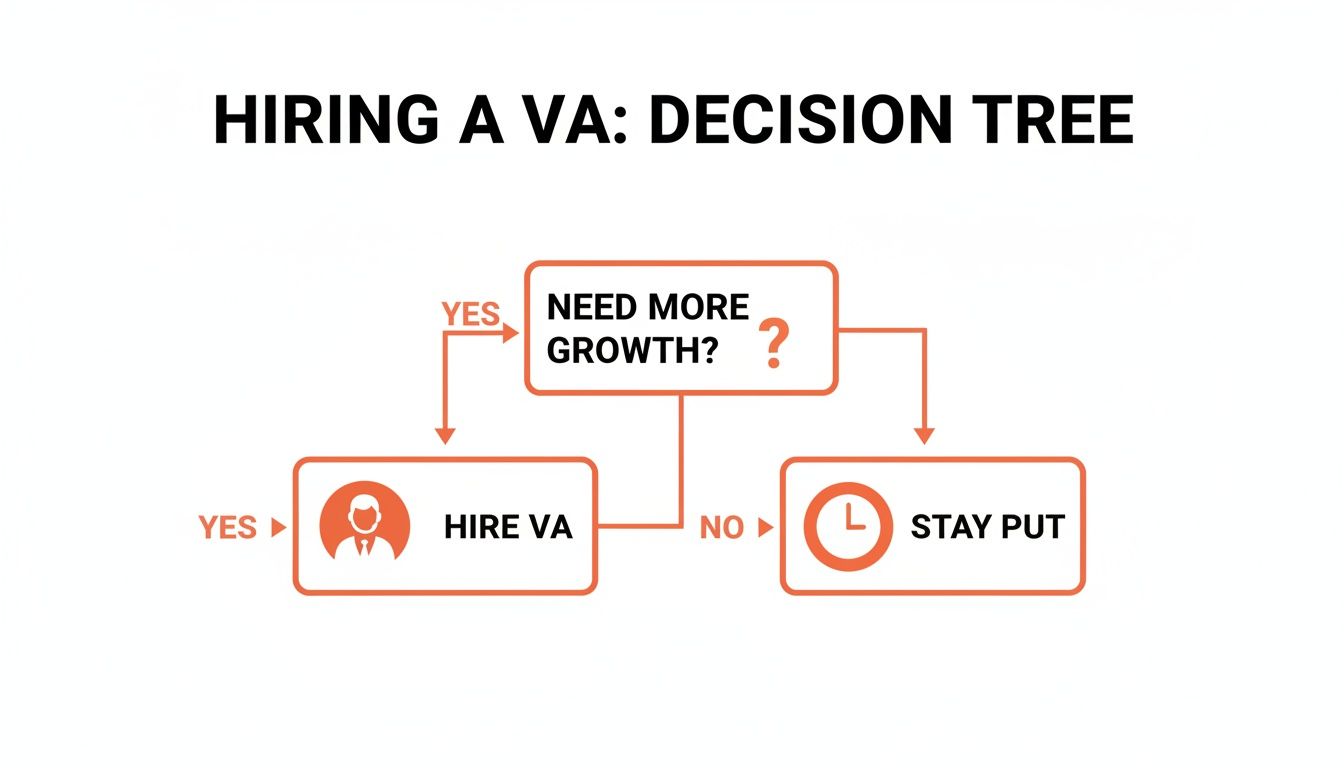
It really boils down to this: if your goal is to grow, bringing on help is almost inevitable. If you're happy where you are, you can probably keep doing what you're doing.
Hiring Model Comparison: Freelance vs. Agency vs. Direct Hire
To make the choice even clearer, let's break down the three hiring models side-by-side. Each serves a different purpose, and what works for a top-producing team might be overkill for a solo agent just starting to delegate.
Ultimately, there's no single "best" option—only the best option for your business right now. A freelancer might be perfect to handle your social media this quarter, while an agency VA could become your go-to transaction coordinator for the long haul.
Creating a Job Description That Attracts the Best
Once you know how you're going to hire, your next mission is to write a job description that acts like a magnet for top talent. Vague requests get you vague, unqualified applicants. Be crystal clear about what you need done.
Your job description isn't just a list of tasks; it's a marketing document for your business. It should attract candidates who are not only skilled but also genuinely excited about your vision for growth.
Spell out the responsibilities, name the specific software they need to know (like your CRM or MLS), and define what success looks like. For instance, don't just say "manage social media." Instead, try: "Create and schedule 3 engaging Instagram posts per week using Canva and track follower growth in a weekly report."
That level of detail does two things: it scares off the people who can't do the job and attracts the high-caliber virtual real estate assistant who knows they can deliver. This clarity isn't just for the hiring process; it sets the foundation for a great working relationship from day one.
Onboarding Your New VA for Immediate Success

Hiring a talented virtual assistant is just the first step. The real magic—and your return on investment—happens during onboarding. A solid start clears up confusion, builds confidence, and gets your new VA delivering real value from day one.
Think of it like building the guardrails on a highway. Without them, your VA is just guessing, unsure of the rules or the destination. With clear guidance, they can hit the ground running at full speed.
The demand for specialized real estate VAs is exploding for a reason. Projections show the sector growing at a 12.5% CAGR from 2026-2033, a huge piece of a broader VA industry expected to hit $52 billion by 2030. Nailing your process for how to onboard remote employees is no longer a "nice to have"—it's essential.
Setting the Foundation with Clear Systems
First things first: you have to get your processes out of your head and onto paper. You can't delegate what you can't document. This means creating simple Standard Operating Procedures (SOPs) for your core, repeatable tasks.
- Don't overthink it. An SOP can be a simple checklist in a Google Doc, a quick screen recording of you doing the task, or a step-by-step guide with screenshots.
- Start with high-impact tasks. Focus on the daily and weekly stuff first, like how to process a new lead, update the CRM, or schedule a social media post.
- Build a living library. Keep all your SOPs in one shared, easy-to-find place like Google Drive or Notion. Your VA should be able to pull them up anytime they need a refresher.
This little bit of work upfront pays off big time. It slashes your training time and guarantees consistency, no matter who's handling the task.
A great onboarding process doesn’t just transfer information; it transfers ownership. It equips your VA with the tools and clarity they need to take initiative and solve problems independently.
Establishing Communication and Setting Expectations
For any remote working relationship to succeed, you need a clear communication rhythm. From the very beginning, decide how, when, and where you'll connect.
- Define Primary Channels: Don't let communication get messy. Assign specific tools for specific jobs. For example, use Slack for quick daily questions, email for formal client updates, and a project management tool like Asana or Trello for tasks.
- Schedule Regular Check-ins: A quick 15-minute call each morning or a 30-minute sync at the start of the week works wonders. It keeps everyone on the same page and nips potential problems in the bud.
- Set Clear KPIs: Define what a "win" looks like with measurable Key Performance Indicators (KPIs). Instead of saying "handle leads quickly," set a clear goal: "respond to all new web leads within 15 minutes." Other examples could be "create and schedule 5 social media posts per week" or "ensure 100% of transaction deadlines are met."
By setting these ground rules from the jump, you create a professional environment where your real estate assistant virtual knows exactly what's expected and feels empowered to deliver.
Common Questions About Real Estate Virtual Assistants
Even with all the benefits laid out, bringing on a virtual assistant can feel like a big leap. It’s totally normal to have questions about the nuts and bolts—cost, security, and what the day-to-day actually looks like.
Let's walk through some of the most common things agents ask when they're thinking about hiring a real estate assistant virtual. Getting these answers upfront will help you move forward with confidence and make sure you're making a smart move for your business.
How Much Does a Real Estate Virtual Assistant Cost?
This is always the first question, and the honest answer is: it depends. The price tag for a virtual assistant is tied to their location, experience, and how you hire them.
- On freelance platforms, you might find general VAs charging anywhere from $8 to $25 per hour. This can be a solid starting point for one-off projects or simple tasks.
- A specialized, US-based real estate VA or one from a dedicated agency will typically run between $25 to $50+ per hour. These folks come with industry knowledge baked in, so you spend a lot less time training them.
The real trick is to stop thinking of it as an expense and start seeing it as an investment. A lower hourly rate might seem appealing, but it often means you'll invest more of your own time in training and oversight. A higher-priced specialist can hit the ground running, deliver results almost immediately, and generate a return much faster.
How Do I Manage Data Security With a Remote Assistant?
Handing over access to your business information requires a smart, secure approach. Protecting client data is non-negotiable, but thankfully, modern tools make it easy to share access without losing control.
Here are a few best practices:
- Use a password manager like LastPass or 1Password. It lets you grant access to your tools without ever sharing the actual passwords. It's a game-changer.
- Set up a professional company email for your VA. This keeps all business communication centralized and under your control.
- Have them sign a Non-Disclosure Agreement (NDA). This is a standard legal contract that makes confidentiality an official, binding part of your working relationship.
- Limit access in your CRM. Most CRMs let you customize user permissions. You can give your VA access to only the specific information they need to do their job, and nothing more.
What Is the Difference Between a General VA and a Real Estate VA?
This is a really important distinction to understand. A general VA is a jack-of-all-trades, great for handling universal admin tasks like managing your calendar or clearing out your inbox. They’re fantastic for offloading basic office work.
A specialized real estate virtual assistant, on the other hand, is a specialist. They already know the lingo, understand how the MLS works, and are often familiar with real estate CRMs and transaction software from day one. That specialized knowledge means the learning curve is incredibly short, allowing them to jump in and add real value almost immediately.
How Much Time Should I Expect to Spend Managing a VA?
Let’s be real: there’s an upfront time commitment. The first week or two is all about onboarding—training your new VA on your specific systems, tools, and way of doing things.
But once they're settled in, a good VA should be saving you time, not costing you more of it. If you have clear Standard Operating Procedures (SOPs) and good communication, ongoing management can be as simple as a 15-minute daily check-in or a 30-minute weekly call to set priorities.
At Bounti Labs, we want to make your marketing as seamless as your operations. While your new virtual assistant is handling the backend, let our AI take care of the visuals. With Bounti, you can generate stunning property photos, descriptions, and virtual staging from a single video—all in minutes. It's the perfect way to win more clients and close deals faster. See how it works at https://www.bounti.ai.