A comparative market analysis, or CMA, is your single most important tool for building trust and landing on the right list price. It’s so much more than just a report—it’s the data-driven story you tell clients to show them you’ve done the homework.
Our free, downloadable real estate comparative market analysis template (available in Excel, Google Sheets, and Word) gives you the perfect framework to build that story.
The Agent's Edge: A Winning CMA
A solid CMA is the foundation of any great listing presentation. It shifts the pricing conversation from an emotional guess to an objective, fact-based conclusion. When you meticulously compare a client's home to similar, recently sold properties—we call them "comps"—you prove your deep understanding of the market and build unshakable trust.
Getting this right is absolutely critical, especially in a market where every decision feels magnified.
A well-executed CMA helps you:
- Price properties with precision: You’ll sidestep the classic blunders of overpricing (leading to stagnation) or underpricing (leaving serious money on the table).
- Justify your pricing strategy: You can show clients exactly why their home is valued at a specific price, using hard evidence from their own neighborhood.
- Manage seller expectations: A data-driven report grounds the conversation in reality from day one, which makes for a much smoother sales process.
- Win more listings: Handing over a professional, thorough analysis instantly positions you as a true market expert, setting you miles apart from the competition.
Understanding the Core Components
Every winning CMA comes down to a few key ingredients. You start with the subject property, which is your client's home. You'll need all the key details: square footage, bed/bath count, age, and any unique features or recent upgrades.
Next up are the comparable properties, which are the heart and soul of the analysis. These are carefully chosen active, pending, and—most importantly—recently sold homes that are as similar to the subject property as possible.
Finally, you’ll factor in market adjustments and local trends to fine-tune the valuation and provide the necessary context. A truly winning CMA demonstrates a deep grasp of not just valuation but also the larger ecosystem, which is crucial for title and real estate professionals.
To give you a clearer picture, here's a quick rundown of what every comprehensive CMA report should contain.
Key Components of a Comprehensive CMA Report
This table offers a quick-reference summary of the essential elements every professional CMA should include, giving you a clear checklist for success.
Having these components locked down ensures your report is not only professional but also powerful enough to guide your client's decisions effectively.
The global real estate market was valued at $393.3 trillion, with residential homes making up the biggest slice. In such a massive landscape, a real estate comparative market analysis template becomes an indispensable tool for agents trying to make sense of market dynamics for their clients. You can read more about these global real estate market insights.
A great CMA tells a story. It doesn’t just list numbers; it explains what those numbers mean for your client's specific situation, turning raw data into a compelling argument for a smart pricing strategy.
This guide is built around our downloadable template, designed to give you a step-by-step walkthrough to become a CMA powerhouse. Mastering this process is a key differentiator that elevates your service, a strategy often discussed among top-performing listing agents. We'll dive deep into selecting the right comps, making fair adjustments, and presenting your findings with complete authority.
Building Your CMA From the Ground Up
This is where the rubber meets the road. A great CMA isn't just about pulling data; it's about building a compelling, data-driven story that gives your clients the confidence to move forward. Using your real estate comparative market analysis template, you’re about to turn a blank slate into a professional, persuasive report.
The whole process starts with the subject property. Before you even think about comps, you have to become an expert on your client’s home. Every detail matters—from the obvious stats on the tax record to the subtle features that give a home its character.
Gathering the Subject Property Essentials
Your first move is to get every critical detail about the subject property into your template. This isn't just about pulling public records. Think of it as a comprehensive data-gathering mission that forms the bedrock of your entire analysis. A shaky foundation here will compromise everything that follows.
You've got to go beyond the basics. Sure, square footage, lot size, and bedroom count are vital, but the details that truly swing the value are often a layer deeper.
- Document the Specifics: Note the year built, the exact number of full and half baths, garage capacity, and architectural style.
- Identify Key Upgrades: Has the kitchen been remodeled in the last five years? Are the windows new? What about the roof or HVAC system? These are big-ticket items that carry serious weight.
- Assess the Current Condition: Be honest and objective. Is the property in pristine, show-home condition, or does it need some love? This is a massive factor when it comes time for adjustments.
- Note Unique Features: Does it have a pool, a finished basement, a premium corner lot, or a killer view? These are the features that can make a home stand out and significantly influence its final value.
A detailed profile ensures you're comparing apples to apples when you start hunting for comps. An incomplete picture just leads to flawed comparisons and a price that's impossible to defend.
Filling Out Your CMA Template
With the subject property details locked in, you can start building the core of your analysis in the real estate comparative market analysis template. Precision and organization are everything here. Start by picking three to five of the strongest comparable properties you found during your MLS research.
Enter each comp into a separate column in your template, mirroring the same data points you collected for the subject property. This side-by-side layout is what makes the comparison so powerful and easy for clients to grasp.
It’s a simple flow: you understand the property, find its closest matches, and then determine its value.
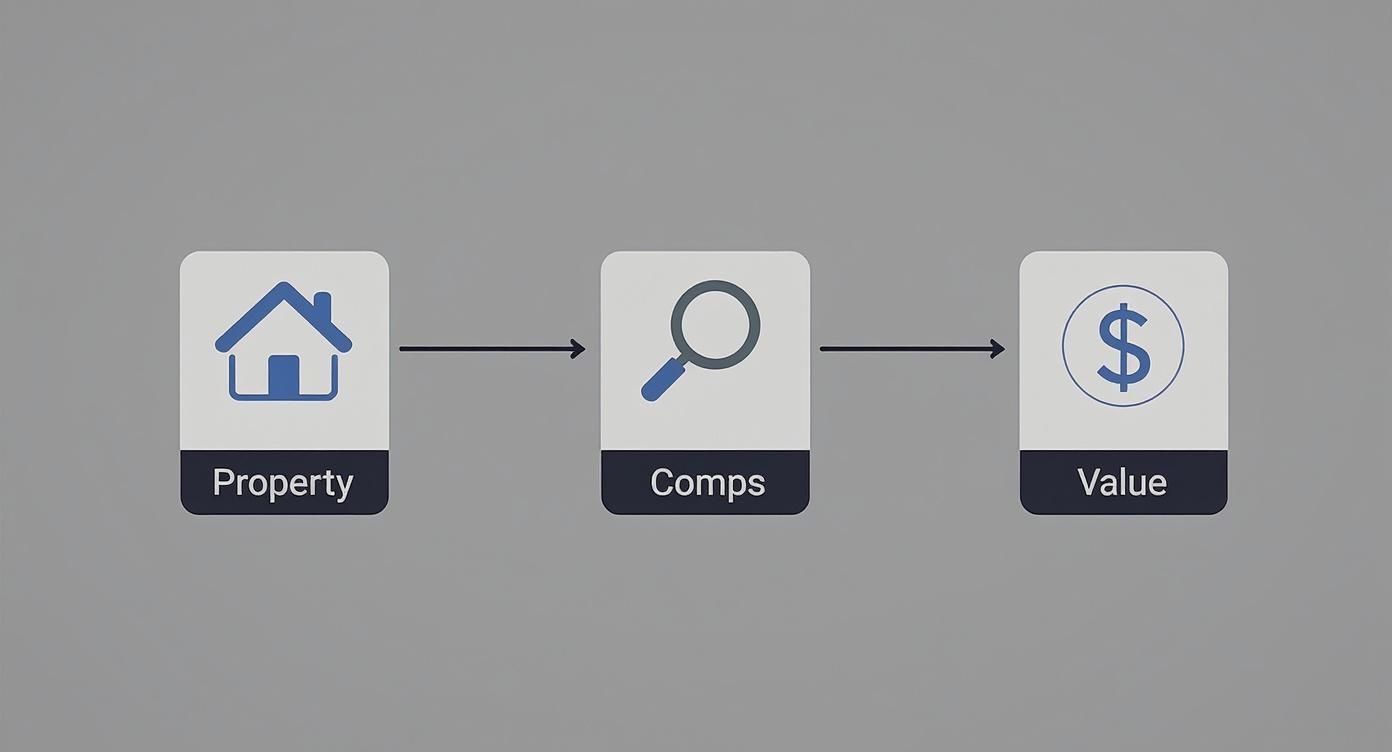
This visual really drives home the point: each step builds directly on the last, creating a logical path to a defensible price.
Once the raw data is in place, the real work begins. This is where you bring your market expertise to the table to account for all the inevitable differences between the subject property and your comps.
Applying Nuanced Adjustments for Accuracy
Let's be real: no two homes are identical. This is where adjustments—the true art and science of valuation—come in. Your template should have dedicated rows for adjustments, letting you add or subtract value from each comp’s sale price to even the playing field.
For instance, if your subject property has a two-car garage but a comparable only has one, you add value to the comp's sale price. On the flip side, if a comp has a stunning, brand-new kitchen and your subject property's is stuck in the 90s, you subtract value from the comp.
A rookie mistake is to use generic, rounded numbers for adjustments. Don't do it. Base your figures on local market data. How much is a full bathroom really worth in your specific market? The answer can vary by thousands of dollars from one neighborhood to the next.
Here’s a quick example of how this works:
- Subject Property: 3 bed, 2 bath, 2,000 sq. ft., 2-car garage.
- Comp #1 (Sold for $500,000): 3 bed, 1 bath, 2,000 sq. ft., 2-car garage.
- Adjustment: If a full bathroom is valued at $15,000 in your market, you would add $15,000 to the comp's price. The adjusted value of Comp #1 becomes $515,000.
You'll repeat this process for every significant difference across all your comps, meticulously fine-tuning each one.
Calculating the Final Price Range
After you've made all the necessary adjustments, you’ll have an "adjusted sale price" for each comparable property. These adjusted prices should, in theory, be clustered much closer together than their original sale prices. This new cluster of values is the foundation for your pricing recommendation.
Instead of just averaging these numbers and calling it a day, the best practice is to present a suggested price range. This approach gives the seller a sense of strategic flexibility and accounts for small market shifts.
For example, if your adjusted comp prices are $515,000, $525,000, and $518,000, a solid suggested listing range would be $515,000 to $525,000. This data-backed range becomes the centerpiece of your pricing conversation, built entirely from the ground up with your real estate comparative market analysis template.
Doing this manually requires serious diligence, but modern platforms can speed things up dramatically. A tool like Bounti Labs, for instance, automates a lot of the data pulling and comp suggestions, letting you focus more on the strategic side of adjustments and presentation. It’s also a great way to standardize CMA creation across an entire team, ensuring every report is consistent, professional, and on-brand.
Finding Comps That Strengthen Your Analysis
Anyone can pull a list of recently sold homes from the MLS. What separates a top agent from everyone else is the ability to select the right comparables—the ones that build an airtight case for your pricing strategy.
This is less about quantity and more about quality. Three perfect comps are infinitely more powerful than ten mediocre ones. You have to start thinking like an appraiser. Your goal is to find properties that a professional appraiser would select, which means prioritizing similarity and recency above all else. This approach ensures your real estate comparative market analysis template is a defensible valuation tool, not just another document.
The Hierarchy of Evidence in Comps
Not all comps are created equal. Knowing the pecking order is crucial for building a credible CMA. The most reliable evidence always comes from closed transactions because they represent proven market value—what a real buyer was actually willing to pay.
Here’s how to prioritize your search:
- Sold Properties: This is your gold standard. These comps provide concrete, historical data points of a property's worth. Focus on sales within the last 90 days to get the most accurate picture of the current market.
- Pending Sales: These are the next best thing. While the final sale price isn't public yet, the list price of a home that went under contract shows what the market is currently willing to accept.
- Active Listings: Treat these as a snapshot of your direct competition. They show you what other sellers are asking, but remember, asking price isn't the sale price. Use them to position your listing competitively, not to determine its value.
A common mistake is giving too much weight to active listings. A property that has been sitting on the market for 60 days isn't a benchmark for success; it's a cautionary tale about overpricing. Always anchor your valuation in what has already sold.
Mastering Your MLS Search Tactics
Your Multiple Listing Service (MLS) is a treasure trove of data, but only if you know how to mine it effectively. A broad, generic search will just give you a list of weak results. Instead, you need to apply specific filters to narrow your focus and find the best possible matches for your subject property.
Start with a tight geographic radius. In a dense urban neighborhood, you might only search within 0.5 miles. In a sprawling suburban area, you might expand to 1-2 miles, and in rural settings, it could be 5 miles or more. The key is to stay within the same neighborhood or a directly comparable one.
From there, start layering on additional filters to match the subject property as closely as possible.
- Time Frame: Begin with sales in the last 90 days. If you can't find enough good comps, you can cautiously expand to 180 days, but be prepared to make a time-based adjustment for market appreciation or depreciation.
- Property Characteristics: Filter by square footage (+/- 15% is a good rule of thumb), bed/bath count, and property style (e.g., colonial, ranch).
- Key Features: If possible, filter by significant features like a two-car garage or a finished basement if those are major value drivers in your area.
Refining these search parameters is one of the most important time-saving strategies for real estate agents. Getting it right upfront means less time sifting through irrelevant properties and more time analyzing the data that truly matters.
Handling Unique Properties with Sparse Data
So what happens when you’re valuing a one-of-a-kind property? Maybe it’s a historic home in a neighborhood of new builds or a property with a massive lot that dwarfs its neighbors. When direct comps are scarce, you have to get creative.
First, expand your search radius to similar, adjacent neighborhoods that attract a similar buyer demographic. Second, you may need to go further back in time—up to a year—but you must apply a market conditions adjustment to account for price changes. Finally, you might need to break the property down into its components, finding separate comps for land value and then adding the estimated value of the structure.
In these tough situations, your documentation is everything. Clearly explain your methodology in your real estate comparative market analysis template, outlining why you chose certain comps and the logic behind your adjustments. Transparency builds trust and shows the seller you’ve done the hard work required to price their unique property accurately.
The Art of Making Defensible Adjustments
Finding good comps is step one, but making smart, defensible adjustments is where your expertise really shines. This is how you level the playing field between slightly different properties, turning a simple comparison into a credible valuation your clients can trust.
The logic is straightforward. If a comparable property has something your client’s home doesn’t (like an extra bathroom), you subtract value from its sale price. If the comp is missing a feature the subject property has, you add value. Each tweak brings the comp closer to what it would have sold for if it were identical to your client’s home.
Grounding Adjustments in Market Reality
A professional CMA leaves no room for guesswork. Every single adjustment has to be backed by local market data and a heavy dose of common sense. A slick kitchen remodel might fetch an extra $25,000 in a high-end neighborhood but only $10,000 in a more budget-conscious area. Your job is knowing that difference.
Before you start plugging in numbers, you need to understand the "contributory value" of common features in your specific market. This is rarely the same as the cost to install it. A homeowner might spend $50,000 on a new pool, but it might only add $20,000 in actual market value.
Here are the usual suspects for adjustments:
- Square Footage: This is one of the biggest drivers of value, typically adjusted using a local price-per-square-foot figure.
- Bedrooms and Bathrooms: An extra full bath almost always adds significant value, while the demand for more bedrooms can vary by neighborhood.
- Condition and Upgrades: A home with a brand-new roof and HVAC system is clearly worth more than one with systems on their last legs.
- Garage and Parking: A two-car garage versus a one-car carport is a standard, non-negotiable adjustment.
- Lot Size and Location: Factors like a corner lot, backing onto a busy road, or having a killer view all need to be accounted for.
The key to a defensible CMA is consistency. Use the same adjustment value for the same feature across all your comps. This creates a transparent, logical framework that builds client trust and will stand up to scrutiny.
Valuing Tangible and Intangible Features
Tangible features—like an extra bathroom—are pretty easy to value. You can usually pull data from appraisers or recent sales to find a typical range. For instance, you might find that a full bathroom consistently adds $12,000 - $18,000 in your market.
Intangibles are where it gets tricky. How do you assign a dollar value to a breathtaking mountain view or the prestige of living on a certain street? This demands a more nuanced approach. The gold standard is finding "paired sales"—two otherwise identical homes where one has the feature and the other doesn't. If that's not possible, you have to lean on your market experience to assign a reasonable, conservative value and be ready to explain your logic.
To give you a starting point, I’ve put together a table of sample adjustment values. Remember, these are just general guidelines. You have to validate these numbers against your own local market data when filling out your real estate comparative market analysis template.
Sample Adjustment Values for Common Property Features
This table offers a reference for typical adjustment ranges to help guide your valuation process.
Every number you plug into your CMA needs a "why" behind it. When your client asks you why you added $12,000 for the neighbor's garage, you need a confident, data-backed answer ready to go. That’s what separates a real estate expert from someone just guessing.
Presenting Your CMA to Build Trust and Win Listings
You’ve done the hard work, crunched the numbers, and built a rock-solid analysis in your real estate comparative market analysis template. But a brilliant CMA is useless if it doesn't actually connect with your client. The presentation is where the magic happens—it’s your chance to turn all that complex data into a clear, persuasive story that builds trust and, ultimately, wins the listing.
Your goal here is to be a guide, not a lecturer. A great presentation makes you a knowledgeable partner in the seller's eyes, not just another agent with a report. Use visuals. Show them a map with the comp locations plotted out. Pull up high-quality photos of each property. This makes the data tangible and way easier for them to digest.

Walking Clients Through Your Findings
Kick things off by explaining your process in simple terms. You don’t need to get into the weeds, but a quick overview of how you chose the comps—proximity, recent sales, key similarities—shows you’ve done your homework. It proves you didn’t just grab a few random addresses from the MLS.
As you go through each comparable property, explain the adjustments you made and, more importantly, why. This is where you really build credibility.
- Explain Adjustments Clearly: Instead of saying, "I adjusted for the bathroom," try this: "This home only had one bathroom and yours has two, so I added $15,000 to its sale price. That number reflects what buyers in our area are consistently paying for that extra feature."
- Tell a Cohesive Story: Frame the comps as part of a larger narrative. You could say, "This first home shows the baseline for our neighborhood. The second one, with its updated kitchen, shows the premium buyers will pay for modern finishes. And this third one, which sat on the market a little longer, is a great example of what happens if we price just a bit too high out of the gate."
This storytelling approach makes the numbers relatable and your logic crystal clear. Honing your delivery is just as critical as the data itself; understanding what makes a good presentation can transform your CMA from a simple report into a seriously powerful tool.
Handling Objections with Data
Even with a perfect report, you should expect questions and pricing objections. Sellers are emotionally and financially invested; of course, they want the highest price possible. This is where your data becomes your best friend.
When a client pushes back, don't get defensive. Just point back to the evidence in your CMA. If they bring up a neighbor’s home that sold for more, be ready to pull up that property and calmly highlight the key differences. Maybe it had a finished basement or sold six months ago when the market was hotter.
The strongest CMAs anticipate objections. If you know there’s an outlier sale in the neighborhood that might confuse your client, include it as a comp and proactively explain why it’s not a direct comparison. This demonstrates thoroughness and builds incredible credibility.
The way we present CMAs has changed. With over 97% of homebuyers starting their search online, the digital presentation is everything. For instance, homes with professional drone photos have been shown to sell 68% faster. Weaving modern marketing realities like this into your conversation reinforces your position as a forward-thinking expert.
Ultimately, a well-presented CMA confirms that your recommended price isn't just an opinion—it's what the market is saying. When you pair this data-driven approach with killer marketing materials, you have a winning formula. For more on creating visuals that pop, check out our guide on the best practices for on-brand property marketing materials.
Answering Your Top CMA Questions
Even with a great template, you're bound to run into a few tricky situations. Let's walk through some of the most common questions agents ask when they're putting together a CMA. Think of this as your field guide for those "what do I do now?" moments.
How Many Comps Should I Really Be Using?
The magic number is usually three to five rock-solid comps. This is one of those areas where quality absolutely smokes quantity. A tight, clean CMA with three nearly identical homes that sold in the last 90 days is infinitely more persuasive than a bloated report with ten so-so comps from the last year.
Always start with the most recent and most similar properties you can find. If you’re in a slower market or a rural area where that’s just not possible, you might have to widen your net. That's okay, but you'll need to be ready to explain why you chose those comps and make clear adjustments for time and location.
A classic mistake is throwing too much data at the client. More comps don't strengthen your analysis—they just muddy the water. Stick to your best evidence to build the clearest, most compelling case for your price.
Is a CMA the Same Thing as an Appraisal?
This is a big one, and you need to be able to explain the difference clearly and confidently. Simply put, a CMA is your expert opinion on a property's market value, designed to help a client set a smart listing price or make a competitive offer. It’s a strategic sales tool.
An appraisal, on the other hand, is a formal, legally-binding valuation done by a state-licensed appraiser. Lenders require it to make sure the property is worth the loan amount. While both you and the appraiser are looking at comparable sales, the appraiser has to follow strict industry standards, like the Uniform Standards of Professional Appraisal Practice (USPAP).
Here's the easiest way to frame it for clients:
- Your CMA: Is a strategic pricing guide for you, the client.
- The Appraisal: Is a risk assessment for the lender.
While the goal is always to have your CMA come in close to the eventual appraisal, they serve fundamentally different purposes.
What if I Can't Find Any Good Comps?
Welcome to the big leagues. Valuing a one-of-a-kind property is where great agents really earn their commission. When you’re dealing with a historic home in a new subdivision, or a house on a uniquely massive lot, you have to get creative.
First, widen your search parameters. Look in adjacent neighborhoods that have a similar vibe and attract the same kind of buyer. You might also have to go back further in time—maybe six months or even a year—but if you do, you must make a market conditions adjustment to account for how prices have changed since then.
Next, you might have to break the property down into its parts. You could find separate comps just for the land value, and then add your estimated value for the structure and its unique features. This approach takes more work, but it shows a deep level of analysis.
Finally, your adjustments become the star of the show. Since the comps aren't perfect mirrors, you’ll lean heavily on logical, well-supported adjustments for all the differences. The key is to document everything you did right there in your real estate comparative market analysis template, explaining exactly how you pieced together the final valuation.
Ready to stop wrestling with spreadsheets and start creating stunning, data-driven CMAs in minutes? Bounti Labs uses AI to automate the entire process, from pulling the best comps to generating a full, on-brand marketing kit.Discover how Bounti can transform your listing process today.